Alice Glasnerová
Blogs:
2017
Thank you, Senator McCarthy: 18 Aug, 2017
Noel Field, soviet spy: 10 Sept, 2017
The
hunting dog finds a scent: 30 Sept, 2017
My past ghost: 24 Oct, 2017
Two worlds: meeting Alice for the first time: 26 Nov, 2017
2018
The London connection: 14 Feb, 2018
Stepping into the shadows: 13 March, 2018
Return
to the land of milk and honey: 22 April, 2018
Return to Czechoslovakia: 7 June, 2018
Dual
heritage: 18 June, 2018
Zilina, then and now: 1 July, 2018
A fateful triangle: Erwin, Noel Field and Alice: 29 Aug, 2018
Friends forever: 23
Oct, 2018
Lost luggage: 6 Nov, 2018
Questions of right and wrong: 20 Dec, 2018
2019
Letters from Alice: 26 Jan, 2019
A tale of two photographs: 1 March, 2019
In her father’s steps she trod: April 17, 2019
Prison visit: May 21, 2019
Cartoons and correctness: May 27, 2019
Visiting the dead: June 10, 2019
Alice in the archives: June 21, 2019
Dislocated worlds: May 12, 2019
Au revoir and not good-
Bienvenida Espana: 8 September 2019
Bullfighting in Albacete: 9 September 2019
Benicasim -
Surrounded by danger: 21 September 2019
Arrivals and departures: 29 September 2019
A place of execution (A cold afternoon): November 29, 2019
Seventy years on: 4 December 2019
Windows into the past: 10 December 2019
2021
Munich revisited: February 28, 2021
Will there be a Holocaust museum in Prague?: October 10, 2021
Statue wars: October 14, 2021
Transitional objects: October 21, 2021
My blogs
A tale of two photographs
March 1, 2019

Alice, Dora Klein and Vlasta Vesela
The first shows three young women, standing together, looking slightly sideways at whoever is taking the picture, as if they are uncertain. In the background there is a promenade, perhaps they are on a beach, but it is windy, they need their coats. It is 1937 in Spain.
The second, taken at least twenty years later in Prague, shows two middle-
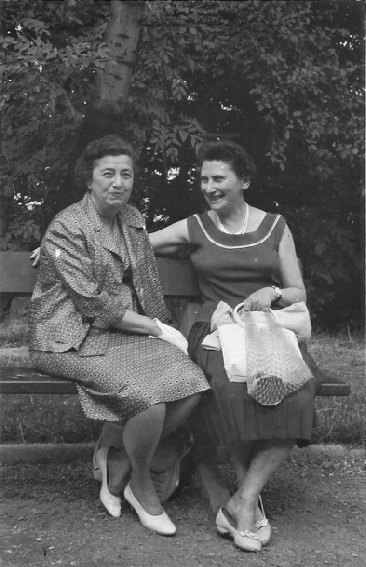
There, in the late 1950s, sit Alice and Dora, well dressed, hair tidy and set, looking like any other conventional and respectable women of their time. They were anything but conventional.
In 1926 Alice graduated from Charles University in Prague. She was to be one of the first female lawyers in Czechoslovakia. A few years later, Dora also graduated from Charles University, but from the medical school. For Alice the journey to Prague had been straightforward, she had friends and relatives there. For Dora, it had been much more difficult. She was born in Poland and her ambition to become a doctor was impossible to realise there; she was Jewish. Her only option was to move to Czechoslovakia, where Jews were welcome in the university.
Different backgrounds, different faculties and different times. While Dora was completing her medical studies, Alice had married a young doctor, Erwin Kohn, and they had settled into their new lives in Zilina. Alice travelled regularly to the courts in Bratislava for work and she and Erwin both became involved in the political parties of their town.
The rise of fascism in Germany was a concern to them all, and for Dora and Alice it seemed that the only party that was willing to fight this rising threat, was the Communist Party. In Spain, as Franco staged a coup against the ruling Republican Party, it was clear where the battle lines were being drawn. Dora and Alice both volunteered their services. Dora was needed as a doctor, but in order to be sent out with the Czech medical contingent, she needed to be a Czech national. She married Viliam Klein to get her citizenship, although his motives may have been personal as well; Dora was an attractive young woman. Alice was prepared to help in whatever way she could. It meant leaving Erwin; he did not share her conviction in the Communist cause. He had seen her growing commitment to the party and she had tried to persuade him to join, but he was adamant, so she made her choice. So, in summer of 1937 after a holiday at Knocke in Belgium with her mother, she sent him a letter explaining that she would not be returning to him, but was going instead to Spain; her letter said they “belonged to different worlds”.
Dora and Alice, each in her own way, left their husbands behind in Czechoslovakia and met in Spain, first in Guadalajara and later in the J.A.Comenius Hospital in Benicasim, where they were joined by the third woman in the trio – Vlasta Vesela. Vlasta had graduated as a doctor from Brno and had already experienced loss and grief, as her fiancee had been killed fighting in Spain. She was more reserved, but always ready to help and with a sharp sense of humour and a sarcastic tongue. Dora was the youngest of the three and described by Egon Ervin Kisch, who knew them all well, as follows: “Dorince, who might be my daughter, and my mother.” She might have been the youngest but she was maternal and warm hearted. In the photograph she stands behind the other two lightly resting her hands on their shoulders, uniting them.
For a short while in Benicasim, the women enjoyed one of the most rewarding and intense periods of their lives. It had been a resort of the wealthy, populated by beautiful villas which were now put into service as hospitals, but the gardens still overflowed with oranges, that to Alice looked like “small suns”. It was a beautiful spot and even though the hospital was filled to overflowing with the injured from the front, these young women knew they were engaged in a noble struggle. Vlasta and Dora worked as doctors, and Alice took over the administration of the hospital, organising the logistics of food, medicines and equipment, but also providing the opportunity for conferences and discussions for the international team of volunteer doctors, enabling them to share knowledge and expertise. She arranged cultural activities for both the staff and the patients, which included outings, film screenings, concerts, sporting events, political reports and Spanish classes. There were at least seven languages in use throughout the hospital, luckily Alice spoke several of them: English, French, Czech/Slovak, German. In addition, a radio system was rigged up between the buildings to entertain the patients. E.E.Kisch, whose brother Bedrich was working in Spain as a doctor, also stayed at the hospital and helped with its cultural life, sometimes giving lectures himself.
However, by the summer of 1938, Franco’s troops were advancing towards Benicasim
and the hospital was forced to close. Dora and Vlasta fled to France and managed
to reach Paris, where they contacted a group of other Czech inter-
The war was a threat to all three women, who were both Jewish and Communists. At
this point, it was Alice who had the more fortunate outcome, as Erwin, although brought
up in Czechoslovakia to Czech parents, had been born in America and had American
citizenship. He and Alice were able to emigrate and spend the war in America, where
he joined the US army. While there, she continued her work with the Communist party,
helping emigres from Czechoslovakia obtain visas and enabling them to settle in the
USA. Among those she helped were Voskovec and Werich, the well known Czech dramatists
and film-
Dora and Vlasta were in France when war broke out and Vlasta worked with the Czech
resistance there, until the Nazi occupation forced her to flee to Switzerland, where
she was interned. Dora was deported to Auschwitz in 1943, but survived the war. Sadly,
her husband of so few years, was not as lucky. After the war, she worked for the
Czechoslovak Repatriation Committee. Vlasta, who by this time was living with Rudolf
Feigl, worked with him on post-
Having survived the war, with their country liberated from the Nazis and now with
the Communist Party in charge – the party for which all three of them had worked
tirelessly throughout their young adult lives-
None of them realised that they each represented a very dangerous cocktail of qualities:
first, they were Jewish; second, they had all spent time abroad; third, they all
knew Noel Field. At first sight, these may not seem to be dangerous attributes; after
all, the Communist Party had encouraged Jews to join and had set themselves up in
opposition to the anti-
They had no idea that they were about to enter the looking glass world in which everything is reversed. Soviet encouragement of the Jews ended as the Western allies placed their support behind Israel; Israel and by extension the Jews started to look like a threat. These women hadn’t just travelled abroad, they understood other cultures, they spoke several languages, they were well educated and intelligent, they thought for themselves. At a time when the USSR started to see threats to communist ideology and influence both from the West and from within their own sphere of influence when Tito rejected the Soviet model of communism, the Soviets wanted blind obedience. In order to encourage it, they wanted to unite the satellite countries against the threat of bourgeois imperialism from the West. The way in which they chose to do this was by creating an “enemy within” a sinister spy plot whose aim was to destroy the communist states. They began in Hungary with the Rajk trial, but soon moved on to Czechoslovakia, determined to uncover a similar plot. Noel Field was the ideal instrument for their purposes. He was an American with many links to the Czech emigres. Vlasta and Dora had met him through their humanitarian work in Europe, and Alice had met him while she was in America. He had offered her a job, but she had suggested he offer it to Erwin instead, so both he and Alice met Noel Field on a number of occasions.
In 1949 Noel Field was arrested in Czechoslovakia, deported to Hungary and interrogated, he named the people with whom he had been in contact. As a result, Alice, Vlasta and Dora were among the many arrested, interrogated and imprisoned in their own country, accused of espionage. Alice and Dora remained in prison for several years before their cases came to court, during which time, like all the other political prisoners, they were subjected to vicious interrogations which continued throughout the night. They were insulted as Jews, deprived of sleep and water, forced to walk endlessly around their cells. Incessant interrogations were used to try and implicate as many others as possible and those Jews in particular who were high up in the party, culminating in the Slansky show trial of 1952. Vlasta’s lover, Rudolf Feigl, was condemned to twelve years in prison and of the fourteen Slansky defendants, eleven were condemned to death.
It was a final horror that Vlasta would not see. When she was imprisoned, she fought against every accusation, refusing to testify and protesting by going on hunger strikes on three occasions. Despite being force fed, she became so weak that she was unable to get up from her bed. The prison doctor wanted her transferred to a hospital, but Karel Svab, who was responsible for the arrest of all three women. refused, saying: “She’s got what she wanted. We don’t need her any more.” Instead, she was given sleeping pills, which she hoarded, until finally she had enough to take her own life. She died leaving a message scraped into the dust: “I am dying for my country.” It is believed now that the authorities were aware of her intentions. In one of her rare comments about life in the prison Alice said she had once heard Vlasta, who was imprisoned along the same corridor as she was, making a “desperate cry, the uncontrolled cry of a mad woman.”
Vlasta died in 1950. Dora and Alice survived, and in 1954, were finally convicted of spying as part of Noel Field’s spy ring. The charges against Dora were so weak that even the prosecutor proposed the proceedings be dropped. A year later, after letters and petitions for mercy to have the sentences reduced, the women were released. A number of factors were taken into account, including Alice’s desperate state of health. According to the doctor from Pankrac Prison she was, “physically weak, anaemic”, and was suffering from “an arterial defect, spinal tuberculosis, intervertebral disc herniation, bilateral sciatic nerve neuralgia, chronic gastric catarrh and jaundice”. In his judgement, if she was not released, she would face permanent invalidity or premature death.
It was not long before the truth began to emerge and Alice and Dora, along with hundreds of other victims of the show trial era, were completely exonerated. Those who had imprisoned and tortured them were shown to have acted illegally. However, when they were arrested, they had been stripped of all their possessions and rights as citizens, it was a long struggle to have them restored. But they had lost far more than this. When Dora was arrested, she had been in a relationship with a Polish doctor, whom she had met in Spain and with whom she had a son, a child from whom she had been separated for four years.
Alice and Dora had both been arrested in 1951, but Alice had spent spent nine months in prison before that, between July 1949 and March 1950. One of the conditions of her release on that occasion was that she divorce Erwin. They were already separated; he had taken up the offer of a job with the World Health Organisation in Geneva and she had refused to accompany him as she wanted to stay in Czechoslovakia, but no further decisions had been made. Now, the decision was made for her. She never remarried.
The two pictures tell a story of three brave, idealistic, independent women, who were prepared to risk everything for their beliefs. They were sent to me by Dora’s son, who contacted me a few months ago through this blog, and were the first proper photographs of Alice I had ever seen. It is a joy to see that second picture of Alice and Dora laughing together; there was life and fun to be had after the horrors and grief of the past. The only shadow is the loss of that third figure, who should have been there to share too in that laughter, but whose final legacy is one of defiance and despair. In their later years Dora and Alice met often and shared memories of their year in Spain, but of the years imprisoned in their own country, at the hands of their own comrades, they remained silent.
Sources:
Ministerstvo o Spravedlnosti v Praze
Čislo: 0 203/55-
Národní Archiv:
Poznamka M.Tauchmanová
KSČ-
Svazek: 11
Archivní jednotka: 338
Svazek: 7b
Archivní jednotka: 130
Neviditelny Pes>Společnost>Historie
4.10. LIDÉ: Zdálo se, že vůbec nezná strach Jaroslav Bouček
AMI RGASPI 545-
Kulturarbeit in Benecasim Dr Alice Glasner.